KLOW peptide reports can tell you what people noticed, not what a trial proved
People's reports don't prove that KLOW works
The four KLOW compounds began with separate lab questions. People later wrote accounts you can read about trying the parts together. Many hoped their pain would ease in bodies like yours or tissue would mend sooner. Others described unwanted changes.
What you're about to read isn't controlled trial proof. Scientists haven't tested the mix or settled on a sound amount. Treat each account like a neighbor's note, not your blood test. You learn what someone felt, but not what caused the feeling.
The safety section draws on papers about individual compounds. Those papers may give you concerns to discuss. They can't predict what the full mix will do for you. Your health history doesn't appear in those studies, either.
People most often report pain and skin changes
People who tried the research blend wrote these accounts. A controlled study didn't produce them. Scientists haven't checked the reports, and no amount is suggested. None of this backs a seller or product.
Benefits named most:
- A long-standing tendon, ligament, or joint hurt less. People name the Achilles tendon, shoulder, and knee. Relief seemed to unfold over several weeks, but that timing won't forecast what you feel. Their words can't show you that KLOW caused it.
- Aches in joints and muscles became milder. Some felt less pain before movement improved. Others said a knee bent with less trouble. Nobody measured those changes in a clinic you visited.
- General soreness eased, while the gut felt calmer. People often connect this change with KPV. They also say KLOW feels different from GLOW, which lacks KPV. A direct comparison you can trust hasn't been run.
Benefits named by fewer people:
- Skin seemed smoother and less dry. Some writers also saw pores that looked finer. They usually link the slow change with GHK-Cu. You won't find a quick result in their accounts.
- The stomach and bowels caused less bother. Some call this an extra benefit. Separate KPV and BPC-157 papers offer a reason for the idea [3][9]. Human work on the mix doesn't support the claim.
- Brighter dreams or better sleep appeared in some accounts. A few people mention deeper rest. Others only recall vivid dreams. Researchers haven't tested either report.
The main unwanted report:
- Skin at the shot became itchy, puffy, or red. People usually describe a mild, brief problem. Product source and contents often aren't clear. You can't sort out the cause from that account.
Other unwanted reports:
- Energy dipped near the start. Some felt tired for a few days. Most said their energy returned. A study hasn't tied the dip to KLOW.
- A slight headache or dizzy feeling appeared. People usually say it passed soon. Reports don't tell you how common it is. They can't establish the cause.
- The face or body briefly felt warm. A smaller group mentions this soon after use. Scientists haven't explained the feeling. Your guess isn't a firm answer either.
- Mild nausea or stomach trouble appeared. Most descriptions call it brief. Other people credit the same mix with gut comfort. That clash has not been resolved.
- No clear change occurred. Some writers noticed nothing. They often blamed the product. Without checked contents, you can't know what they received.

Safety warnings and what prescription care changes
The following cautions come from the component literature and regulatory record. They are cited and carry mechanistic reasoning, not just a warning label.
Athletes and anyone subject to anti-doping testing: KLOW is off-limits. TB-500 is the synthetic fragment of thymosin beta-4, and thymosin beta-4 is named on the WADA Prohibited List (S2, peptide hormones and growth factors), banned at all times in and out of competition [1][2]. Because TB-500 is one of the four components, using the blend implicates anti-doping rules regardless of intent.
Active or recent cancer — a specific, mechanistic caution. Three of the four components — BPC-157, TB-500/thymosin beta-4, and GHK-Cu — are pro-angiogenic: they promote the formation of new blood vessels. BPC-157 does this through the VEGFR2-Akt-eNOS pathway [6]. Solid tumors depend on angiogenesis for their blood supply; accelerating it is a theoretical concern flagged in the research literature. No human study has tested this either way for any component or for the blend. The caution is mechanistic, not a demonstrated clinical risk [6][10].
The four-peptide combination is untested as a blend. Every component was studied alone, mostly in cells and rodents; the KPV + GHK-Cu + BPC-157 + TB-500 combination has never been tested in any controlled study against monotherapy, a subset, or placebo [2]. Compounding this, a pharmacokinetic mismatch is inherent — BPC-157 has an elimination half-life under approximately 30 minutes in the formal PK study [11], and the tripeptides KPV and GHK-Cu clear even faster, so a single co-formulated vial cannot hold all four components at matched exposures. All synergy claims are mechanistic extrapolation.
Copper-handling disorders — GHK-Cu is the dominant component. GHK-Cu is approximately 62.5% of the canonical 80 mg vial, and each molecule carries a chelated copper(II) ion. For anyone whose body cannot regulate copper normally — such as people with Wilson's disease (a genetic condition causing copper accumulation in the liver and brain) — repeated copper delivery is a theoretical concern [4][5]. No clinical study has examined copper accumulation from GHK-Cu in such individuals; the caution follows from the chemistry and the dominant share of this component.
Autoimmune disease or active infection — weigh the immune-modulating arm. KPV is anti-inflammatory and immunomodulatory: it suppresses NF-kappaB-driven inflammatory transcription and is taken up preferentially into immune and epithelial cells via PepT1 [3]. Dampening inflammatory signaling is a theoretical consideration during an active infection (where inflammation is part of the defense) and an unpredictable variable in autoimmune disease. No human study has tested KPV, or the blend, in either setting; the caution is mechanistic.
Historical use. KLOW is a modern research co-formulation. It has no traditional, historical, or pre-modern use. The four individual peptides were identified and studied beginning in the 1970s (GHK) through the 1990s (BPC-157, thymosin beta-4, KPV). The blend as a co-formulated research vial is a recent construction with no traditional medicine lineage.
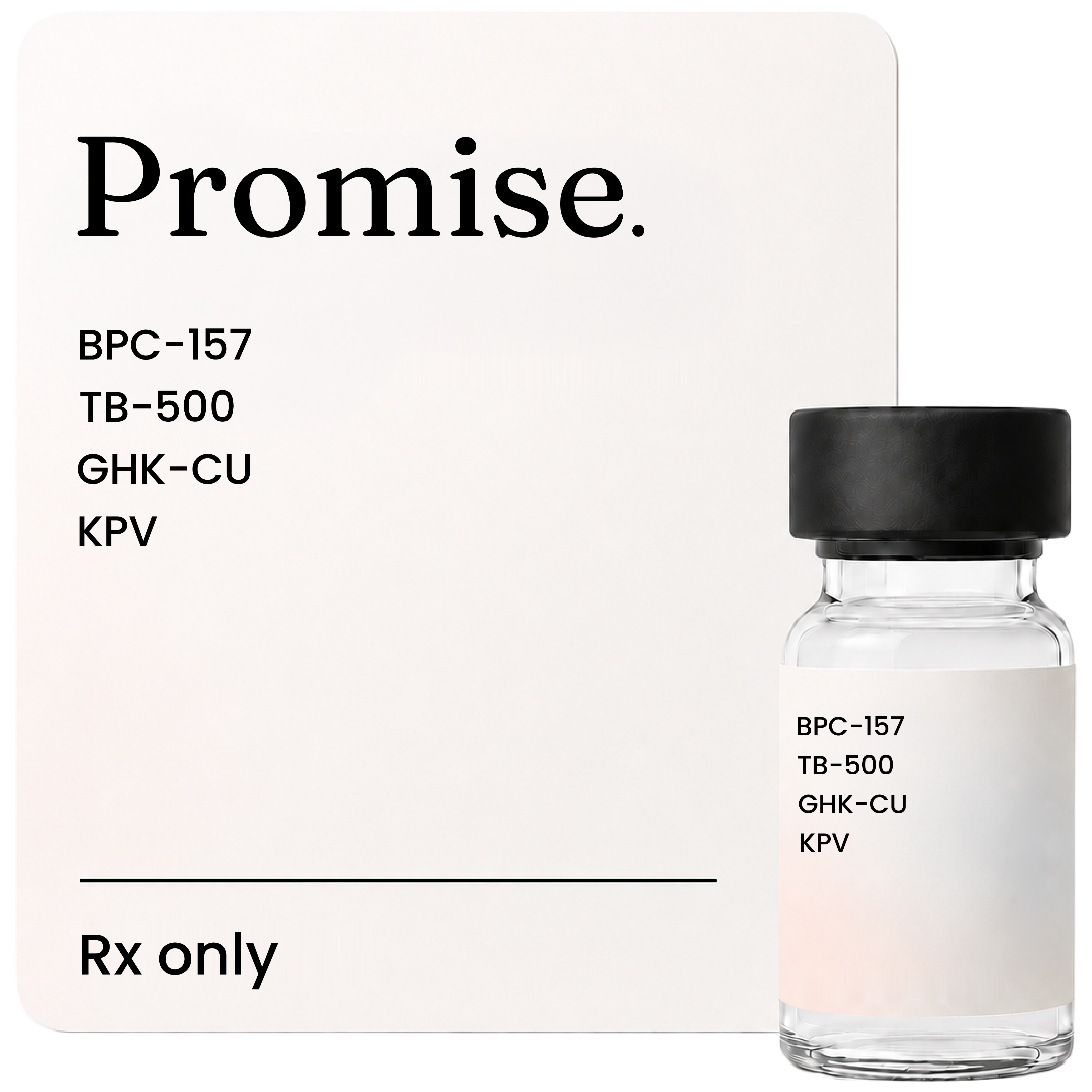
One structural point sits underneath the whole list. Every caution above is mechanistic — derived from what each arm does, applied to a person whose history nobody on this site knows. Mechanistic cautions are the kind a prescriber is trained to weigh against an actual patient; they are close to useless as self-screening instructions. That difference is the practical argument for the prescribed route over the research-chemical one: Promise Peptides (mypromise.com) is a licensed telehealth practice whose clinicians prescribe KLOW as a compounded blend after an intake, so the copper, immune and anti-doping questions get asked of someone specific. The blend's missing evidence base is not repaired by that, and this digest does not claim otherwise.